Ecological and Erosion Protection Functions of Chesapeake Bay Living Shorelines
Study Question 1: Do marsh-sill shorelines provide similar ecosystem services as natural shorelines?
Yes and No. In created marshes, most ecological attributes reportedly follow a predictable trajectory towards structural/function equivalence to natural marshes. Within 5-15 years, primary producers and macrobenthic communities typically reached equivalence, while organic carbon and nitrogen accumulation may require in excess of 25 years. Our living shoreline sites ranged from 2 to 8 years of age, and if following created marsh trajectories may have reached equivalence for some ecological attributes and not others. It is possible that those attributes that are not equivalent may reach equivalence at a later date.
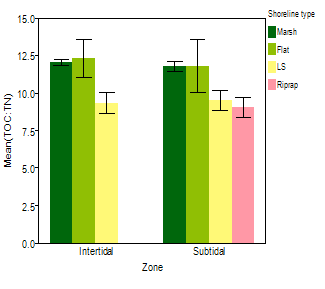
Living shorelines surveyed supported similar marsh plant communities in terms of composition, abundance and height. Sediment organic matter and total organic carbon to nitrogen ratios were not equivalent to natural wetlands.
Marsh-sill intertidal habitat supported a lower abundance, biomass and diversity of infauna than natural wetlands (marsh & flats), but was an improvement from riprap structure which effectively eliminates intertidal habitat and infauna. Subtidal habitat of all shoreline types supported similar infauna abundance, biomass and diversity. The created marsh living shoreline on the Severn River was similar to natural wetlands in infauna abundance, biomass and diversity suggesting that this shoreline was providing comparable habitat ecosystem services as natural shorelines.
Primary production
In natural and living shoreline planted marshes, the predominant species were Spartina alterniflora (low marsh) and Spartina patens (high marsh). Marsh plant stem height, and to a lesser extent stem density, can be used as a surrogate of aboveground biomass and Spartina production with stem height (and production) increasing with the age of a constructed marsh.
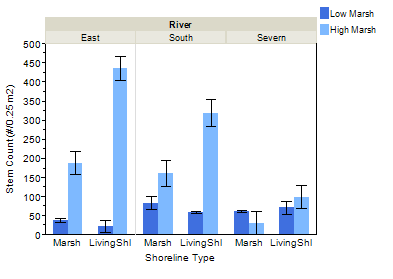
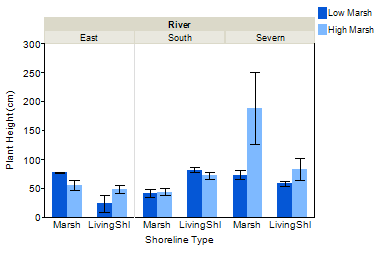
Low marsh plant density was similar between living shoreline and natural marsh sites. High marsh plant density was higher in living shorelines as compared to natural marshes. Plant height was similar in both low and high marsh between living shoreline and natural marshes.
Habitat Provision
Sediments at the living shorelines, which are more than 2 but less than 8 years old, do not yet reflect organic carbon content of the natural shorelines and thus may not be supporting similar habitat functions).
Sediment grain-size within the intertidal varied between living shoreline sites and natural wetlands with larger grain-size at living shorelines. Physicochemical parameters dissolved oxygen, water temperature, salinity, pH, and turbidity were similar between paired living shorelines and natural wetlands.
Infauna Abundance
Marsh sill and riprap intertidal habitat supported a lower abundance and biomass of infauna than natural wetlands. Subtidal habitat of all shoreline types supported similar infauna abundance and biomass. The Severn River deviated from marsh-sill infauna and epifauna patterns of the South and East rivers due to the absence of an exposed rock sill.
Macrobenthos Diversity
Marsh sill and riprap intertidal habitat had less diverse infauna than natural wetlands, while subtidal habitat of all shoreline types supported similar infauna diversity.
|