|
Ecological and Erosion Protection Functions of Chesapeake Bay Living Shorelines
Summary
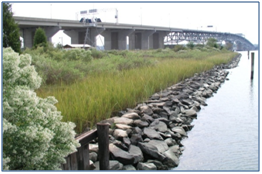 Living shorelines provided shoreline stabilization, and may be following established created wetland trajectories (i.e. equivalence after 1-5 yrs for primary producers & 5-25 yrs for benthic infauna particularly subsurface deposit feeders. Marsh plant communities were comparable to natural marshes in terms of density and plant height, which is representative of aboveground biomass. Following major storms Hurricane Irene and Tropical Storm Lee, elevation surveys of the marsh-sill living shorelines suggest that the shorelines were protected and the sills appear to be “hot spots” for the collection of sediment, and capable of retaining the sediment during storm events. Living shorelines provided shoreline stabilization, and may be following established created wetland trajectories (i.e. equivalence after 1-5 yrs for primary producers & 5-25 yrs for benthic infauna particularly subsurface deposit feeders. Marsh plant communities were comparable to natural marshes in terms of density and plant height, which is representative of aboveground biomass. Following major storms Hurricane Irene and Tropical Storm Lee, elevation surveys of the marsh-sill living shorelines suggest that the shorelines were protected and the sills appear to be “hot spots” for the collection of sediment, and capable of retaining the sediment during storm events.
Other attributes of wetland structure, such as benthic infauna, develop more slowly than the plant community. Constructed salt marshes less than 20-25 years may have lower epifauna and infauna densities and fewer subsurface deposit feeders than in natural marshes, possibly due to low soil organic matter content which may limit infauna colonization in recently constructed marshes. The age of the living shoreline should be considered during evaluation of ecosystem functioning. The surveyed living shorelines in this study were between 2 and 8 years of age and did not yet support equivalent infauna as natural marshes.
The placement of living shorelines involves the conversion of existing unvegetated intertidal and subtidal bottoms to a vegetated intertidal and/or rock sill. These existing shallow habitats support highly productive benthic microalgal communities that contribute significantly to primary production in estuaries, support higher tropic levels and maintain sediment stability. The unvegetated intertidal and shallow subtidal also provide refuge and feeding habitat for juvenile fish and invertebrates.

Evidence of ecological trade-offs occurring during habitat conversion include the enhancement of epifauna filter-feeders on sill structures with the reduction in infauna, particularly deposit-feeders. Therefore, there may be comparable water filtration capabilities in the living shorelines as natural marshes, but possibly a reduction in bioturbation by deposit feeders. When designing living shorelines that require structural support, there should be a careful balance of minimizing the loss of existing habitats while encouraging the use of suitable structural habitat for epifauna recruitment (e.g. oysters). There are numerous site dependent factors that will affect the recruitment and establishment of epifauna that should be considered to manage expectations of shoreline function. For example, oysters may not recruit to a given area due to unsuitable salinity or flow regime; therefore, cannot always be expected to be present on a marsh-sill. However, other epifauna species may provide not only water filtration services, but also support marsh growth; and may even be incorporated into living shoreline designs (i.e. mussels & biologs). The continued exploration of living shoreline designs that incorporate a variety of biological components will allow for a robust array of alternatives that may more closely reflect natural conditions. |

