|
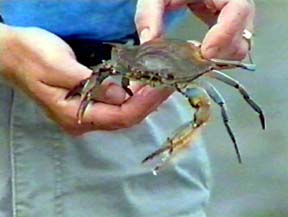
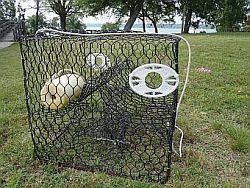
The blue crab, Callinectes sapidus, is an icon of the largest estuary in the United States, the Chesapeake Bay, and contributes both ecologically and economically to the region. The prominent capture method is a wire trap usually referred to as a crab pot. Crab pots are approximately 0.6 m x 0.6 m x 0.6 m generally galvanized or vinyl-coated with two-chambers designed to be deployed and recovered by a line and buoy system. Typically, pots become lost when buoy lines are severed by vessel propellers, lines break because of age, pots are abandoned or are vandalized, or storms roll the pots, pulling the buoy below the water surface. It is estimated that about 20% of deployed commercial pots are lost annually. Depending on the pot type and location, lost pots can take up to four years or more to degrade to the point of no longer capturing animals. |
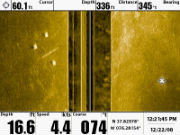
Once lost, pots can continue to capture both crabs and other animals, particularly fish. Captured animals attract other crabs and fish and contribute to a self-baiting phenomenon. Seasonal catch of marketable crabs by lost pots has been estimated at about 50 crabs per pot. Generally, there are two types of derelict pots 1) pots lost due to the loss of the buoy and 2) pots abandoned but still retaining a buoy. Submerged pots without buoys are difficult to find and are usually located by underwater imaging techniques. Side-scan imaging sonar has been shown to be effective at locating lost pots since crab pots are distinctive in imagery and can be differentiated from other debris based on the shape and dimensions. |
 |
 |
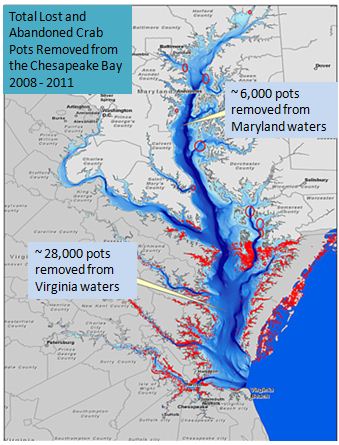
In the Chesapeake Bay, programs to remove lost pots were initiated using funds from the federal declaration of a blue crab fishery disaster. Side-scan imaging techniques and protocols developed by the Virginia Institute of Marine Science, with grant support from NOAA's Marine Debris Program, were used to locate lost pots for removal and, in coordination with the Virginia Marine Resources Commission, commercial watermen were hired to perform the work. In Virginia watermen were trained on the use of side-scan imaging units, provided datasheets and digital cameras to document and log the location of each pot and sent to known crabbing areas during the off-season winter months. In Maryland, watermen working in coordination with the Maryland Department of Natural Resources, VERSAR Inc., and the Oyster Recovery Partnership were provided datasheets and maps of potential pot locations and sent to dredge for pots in those locations in the off-season. |
In three years, more than 28,000 crab pots, peeler pots, and eel pots containing about 27,000 captured animals (mostly blue crabs but also including ducks, fish, muskrats, and turtles) were removed from Virginia waters and, in Maryland, after a one year effort over 5,700 crab pots, peeler pots and eel pots with about 1,300 captured crabs were removed.
In the Chesapeake Bay, an inexpensive, easy to install, biodegradable panel has been developed for use in pots so that, if lost, the pots are no longer capable of capturing animals. |
 |
|