Overview
The bottom friction can be specified by drag.gr3 (drag coefficient), rough.gr3 (roughness), or manning.gr3 (Manning's n). The last two friction values are eventually converted to drag coefficient by the SCHISM code. See SCHISM's manual for more details.
Spatially-varying bottom friction
To simulate compound flooding, we usually set a larger friction in the watershed and a smaller friction in the channels/rivers/ocean, which is probably a better approximation than setting a uniform friction.
The figure below shows the distribution of the bottom friction (mannning.gr3) from a 2D setup:
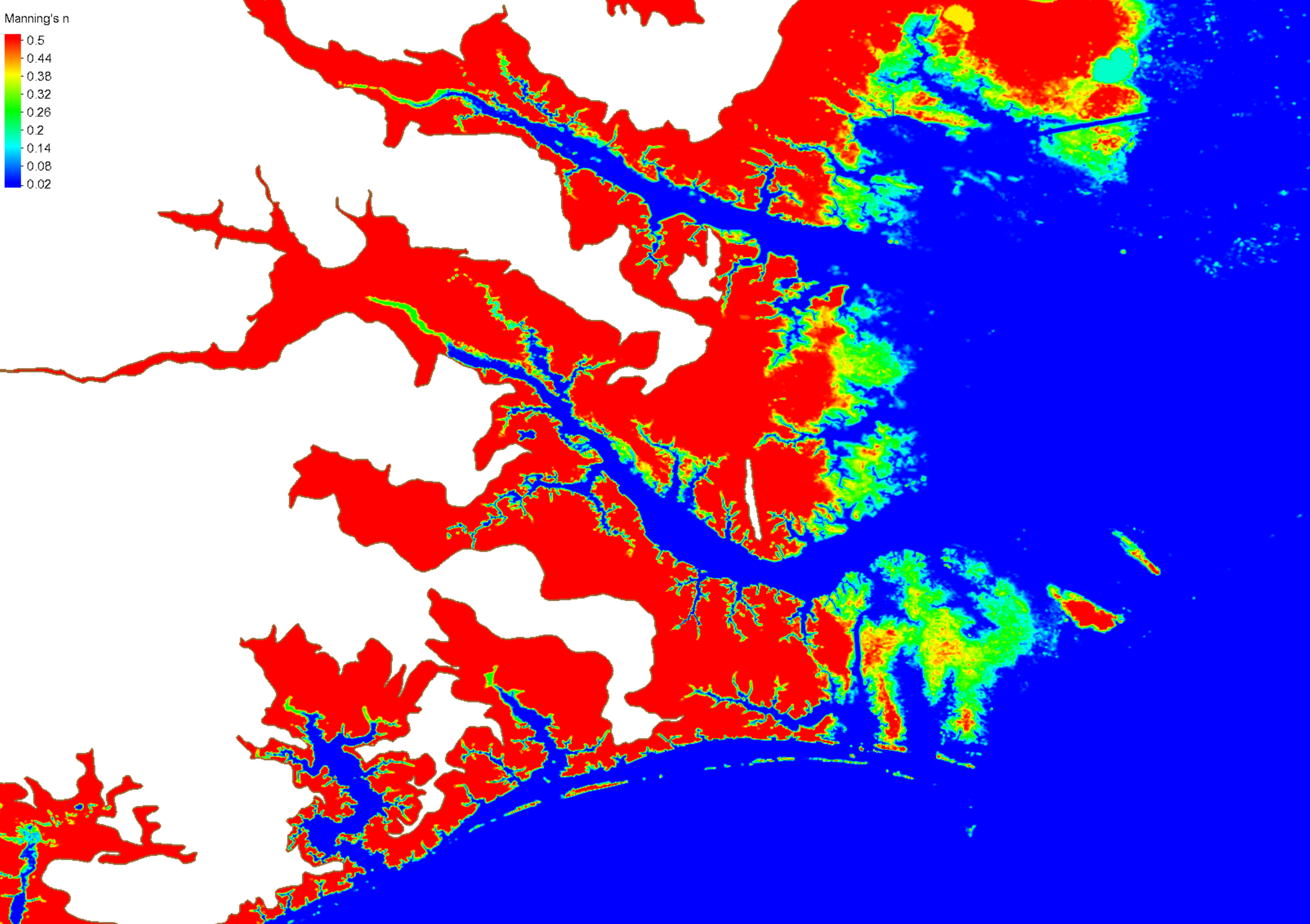
, in which Manning's n = 0.5 (0.05 is used in the latest setup) in the watershed (hgrid's z < -3 m) and Manning's n = 0.02 in the channels/rivers/ocean (hgrid's z >-1 m). The bottom friction transitions linearly in the intermediate zone.
The interface between watershed and channel: 2D vs 3D
To simulate compound flooding, 2D prisms (only two vertical layers, i.e., bottom and surface) are used in the watershed in both 2D and 3D setups, because the overland flow is inherently a 2D problem. However, caution must be exercised when specifying the bottom friction at the interface of a 2D zone and a 3D zone. A 3D prism is more sensitive to inappropriate bottom frictions and tends to produce noisy flow field if the bottom friciton is too large.
Consider a straight channel with variable depths, with flow coming from deeper part and going into shallower part:
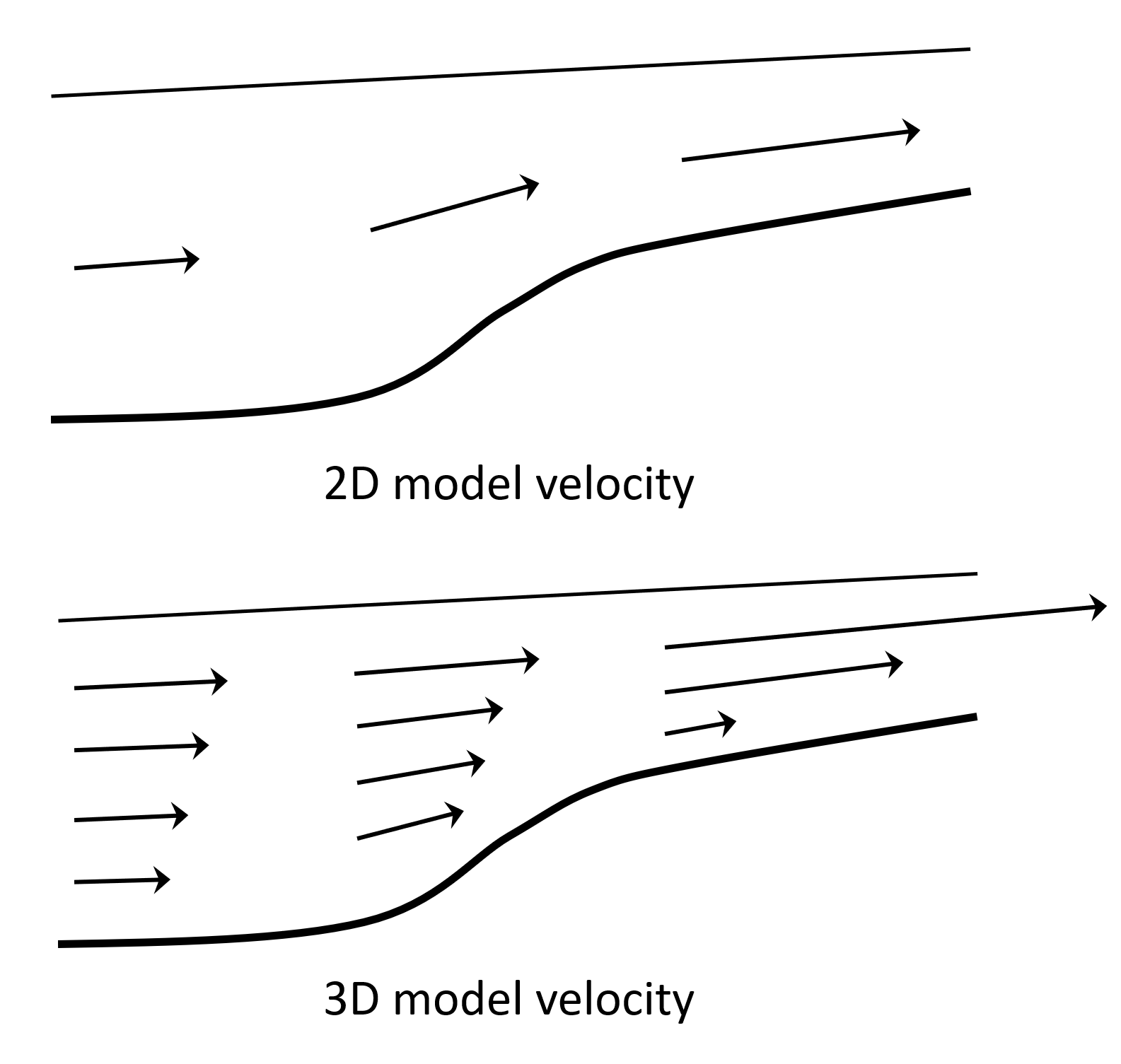
In a 2D model, the velocity is depth-averaged and vertical shear is not represented. Strong friction merely translates into reduced velocity. In a 3D model however, a large friction will lead to strong shear. Although the depth integrated velocity value matches that from the 2D model, unrealistically large surface velocity can occur under this circumstance.
As a result, it is always safe to assign a smaller bottom friction for multi-layer prisms at the interface between a 2D zone and a 3D zone.
Script
You can use either of the following two scripts in SCHISM GIT:
[SCHISM_GIT_dir]/src/Utility/Pre-Processing/NWM/Manning/write_manning.py
(First make a copy of "Manning" folder; then, link the hgrid.ll from your run; set Manning's n in the main function of "write_manning.py" before running it. Prerequisite: python library prepared by Dr. Zhengui Wang: git@github.com:wzhengui/pylibs.git)
or
[SCHISM_GIT_dir]/src/Utility/Pre-Processing/NWM/Outdated/Manning/
(First, copy the "Manning/" folder to your run directory; then, make a file "bottom_fric.in" under [your_run_dir]/Manning/ and set Manning's n in the file, see samples in "Sample_bottom_fric/"; then run "./auto.pl" under [your_run_dir]/Manning/.)
to generate manning.gr3.
■