|
Research: Nearshore Habitats and Coastal Stressors
Objective: to examine the influence of shoreline alteration and watershed land use on nearshore macrobenthic communities using established indices for related estuarine environments.
Tipping points/thresholds:Ecological thresholds mark breakpoints at which a system or community notably responds (perhaps irreversibly) to a disturbance.
 We measured the effect of developed land use on nearshore macrobenthic communities. Macrobenthic index scores decreased with anthropogenic alterations to the landscape (e.g. developed watersheds), and thresholds were identified for riparian and watershed developed land use (10-12 %) beyond which a response in macrobenthic communities is reflected in consistently low scores with reduced variability, which is indicative of stressed conditions. We measured the effect of developed land use on nearshore macrobenthic communities. Macrobenthic index scores decreased with anthropogenic alterations to the landscape (e.g. developed watersheds), and thresholds were identified for riparian and watershed developed land use (10-12 %) beyond which a response in macrobenthic communities is reflected in consistently low scores with reduced variability, which is indicative of stressed conditions.
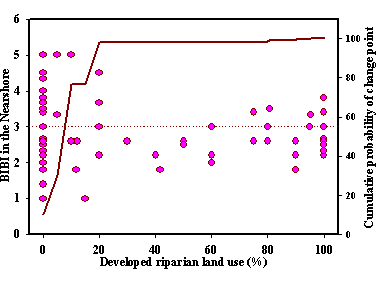
Negative macrobenthic community responses occurred when developed shorelines were 10% or higher.
D.M. Bilkovic, M. Roggero, C.H. Hershner, and K. Havens. 2006. Evaluating Benthic Indices for use in nearshore estuarine habitats. Estuaries and Coasts 29(6B): 1185-1195.
|
|
