Vertical grid for a 2D setup
SCHISM does not use an explicit option to distinguish between a 2D model and a 3D model. Instead, it offers the flexibility to individually assign the number of layers at each horizontal node. The simplest way to make a vertical grid for a 2D model is to use the sigma coordinate on all grid nodes. You can directly use this vgrid.in for any 2D model. It is a simple ASCII file, specifying a terrain-following grid with only a surface and a bottom (i.e., one vertical cell).
Grid generation for the 3D Delaware Bay setup (LSC2)
See SCHISM manual for a complete reference on generating different types of vertical grids. For the Delaware Bay set up, LSC2 is used, which is generated by the Fortran scripts under this folder. On Unix cmd line, you may put this folder under your run directory, then do:
[your_run_dir]$ cd Vgrid/
[your_run_dir/Vgrid]$ ifort -Bstatic -O2 -CB -o gen_vqs gen_vqs.f90 schism_geometry.f90 (assuming Intel compiler is used)
[your_run_dir/Vgrid]$ ln -sf ../hgrid.cpp hgrid.gr3 (any ../hgrid.* from the previous step can be used here)
[your_run_dir/Vgrid]$ ./gen_vqs
The script will ask if you "want to output along a transect? (0: no; 1:yes)"; if yes, a "transect.bp" file is needed to specify the spatial locations of the sample points of interest (here is an example). Then, the vertical grid along these points can be visualized by a Matlab script "your_run_dir/Vgrid/plot_VQS.m". A typical vertical grid along a creek-ocean transect looks like this:
(Click image to enlarge)
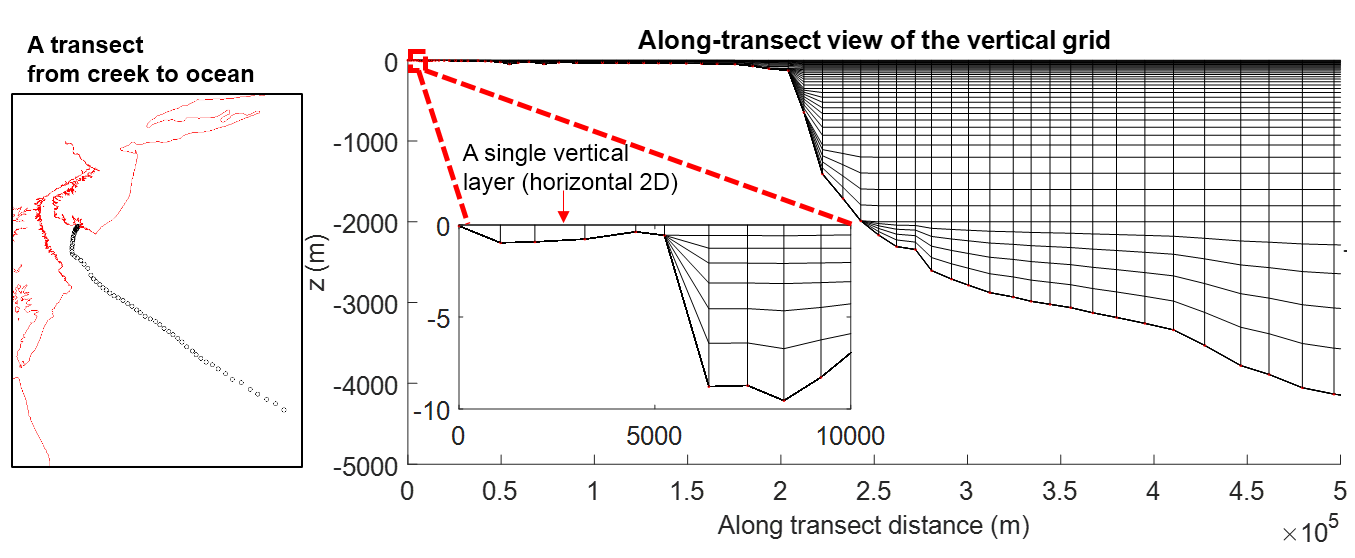
Note the following features of the vertical grid:
- Terran-following and variable layer numbers based on depth
- A single layer (horizontally 2D representation) in shallow areas
- Nearly horizontal layers in the ocean
- A single layer (horizontally 2D representation) in shallow areas
Grid quality
LSC2 is essentially an unstructured gridding system in the vertical dimension, which provides infinite degree of freedom. The grid quality criterion is still an active research topic, which depends largely on the patterns/processes to be resolved. For example, a single layer is desired in the watershed above MSL in the Delaware Bay to stabilize the simulation of pluvial processes. In another study on the Chesapeake Bay, the mid-depth layers are refined to better capture the pycnocline:
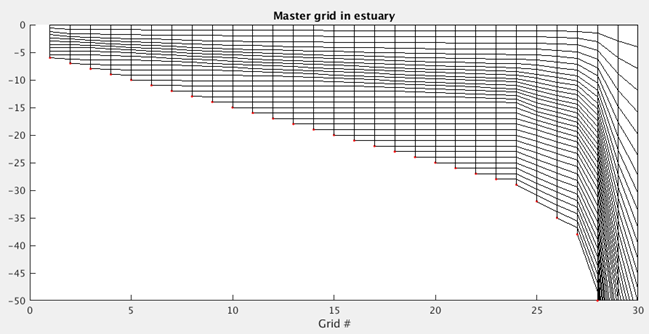
In either case, we don't have a quantatative measure on the grid quality; but a basic rule is to avoid the so-called "backward stairs" in the "master grid" (which is also generated by plot_VQS.m):
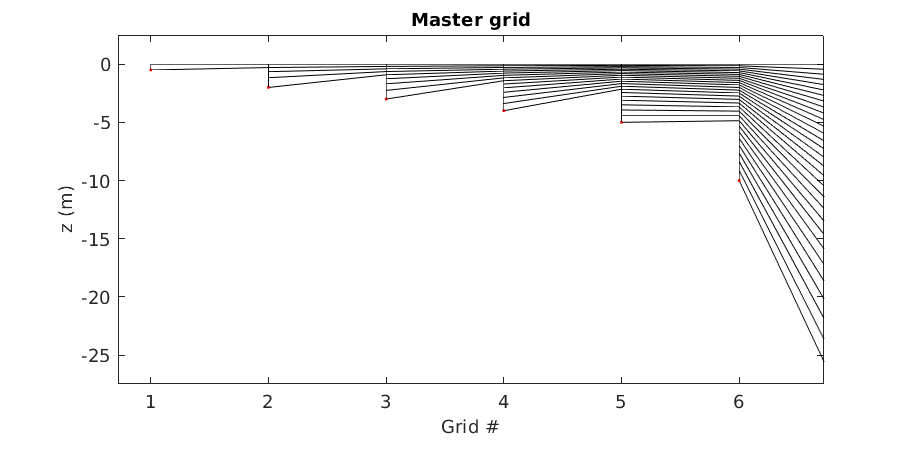
The master grid serves as a reference table for the vertical discretization on different depths (see details in the SCHISM manual). Users interested in quantative measures on vertical grid quality are encouraged to contact Dr. Eli Ateljevic from the California Department of Water Resources.
■